Jul 20, 2026 | New Jersey, Roof Damage, Storm Damage Roof
Northern New Jersey is under a flood watch again. The National Weather Service has posted a flood watch for Bergen, Essex, Passaic, Union, and Hudson counties from Tuesday morning, July 21, through Tuesday evening, with multiple rounds of showers expected on and off from the morning onward and the potential for localized flooding through the day.
On a normal week, a flood watch is routine summer news. This is not a normal week.
The ground has nothing left to absorb
Just three days ago, on Saturday, July 18, parts of North and Central Jersey took 5 to 8 inches of rain in a matter of hours — a flash flood emergency that drew comparisons to Hurricane Ida. Newark police and firefighters pulled drivers from cars trapped in high water at Frelinghuysen and McClellan avenues, flooded streets and underpasses across the region held a foot or two of standing water, a state of emergency was declared, and thousands lost power.
The soil is saturated, streams are running high, and storm drains in many towns are still clearing debris. Tuesday’s rain lands on ground that can’t absorb much more — which means water backs up faster: in streets, in yards, against foundations, and on your roof.
Rain doesn’t need a storm to get into your house — just an opening
Tuesday’s forecast isn’t about wind or hail. It’s about volume and repetition: rounds of rain, hour after hour, on homes that have already been hit by three damaging storms this month — the July 4 wind event, the July 15 hail storm, and Saturday’s deluge.
Steady, repeated rain is how small roof problems become interior damage. Shingles lifted by this month’s winds let water reach the underlayment. Hail-bruised shingles shed granules and thin out exactly where water runs. Flashing loosened around chimneys and valleys wicks water sideways under the roof. And gutters clogged with storm debris overflow against the fascia, sending water behind the trim and down the walls. None of these leak on a dry day. All of them leak in six hours of steady rain.
What to do tonight, before the rain starts
- Clear what you can safely reach from the ground: downspout outlets, splash blocks, and any visible debris at gutter openings. Water needs somewhere to go.
- Make sure downspouts discharge away from the foundation — a downspout dumping at the wall is how basements take water.
- Move valuables off basement floors if your street or basement flooded on Saturday. Same water, same paths.
- Check your ceilings and attic tonight with a flashlight. A faint stain today is where tomorrow’s leak shows up.
- If you already know you have damage from this month’s storms — missing shingles, a tarp, a stain that appeared after July 15 or 18 — don’t wait through another soaking. Call before the rain: (201) 429-9607.
If water comes in on Tuesday
Catch it, contain it, and photograph everything — the ceiling, the attic side if you can reach it safely, and the outside of the house from the ground. Dated photos during the event are the strongest documentation you can have, whether or not you end up filing an insurance claim. Don’t get on the roof in the rain, and be careful around any ceiling that’s sagging or holding water.
An honest note on insurance: policies generally treat sudden storm-created openings differently from long-term wear, and coverage always depends on your specific policy, deductible, and adjuster findings — no contractor can promise an outcome. What helps every claim: dated photos, a record of this month’s storm dates (July 4, 15, 18, and 21), and a professional inspection report tying the damage to them.
Frequently Asked Questions
Can heavy rain alone damage a roof?
Rain alone rarely damages a healthy roof — but it finds every existing weakness. After this month’s wind and hail, many roofs in Bergen, Passaic, and Essex counties have openings their owners don’t know about yet. Volume rain like Tuesday’s is usually when they announce themselves.
Why is my ceiling leaking when there was no storm today?
Repeated soakings saturate underlayment and insulation until water finally shows inside — often days after the damage that caused it. The leak’s cause is usually upstream: a lifted shingle, failed flashing, or an overflowing gutter, not “today’s rain.”
My basement flooded Saturday. Is that a roofing problem?
It can be. Overflowing or clogged gutters dump roof water at the foundation instead of away from it. If your gutters sheeted over during Saturday’s storm, that’s fixable — see our guide on basement water and clogged gutters, and have both roof and gutters inspected free.
Should I wait until after Tuesday’s rain to get an inspection?
If you have no signs of damage, after is fine — we’ll be inspecting all week. If you have any known damage or stains from this month’s storms, call now: temporary protection before hours more of rain is far cheaper than a wet ceiling.
Free roof and gutter inspections before and after the rain
Simple Roofing is based in Wayne and serves all of Passaic, Bergen, and Essex counties. We’ll inspect your roof and gutters free, show you photos of what we find, and give you an honest answer either way.
📞 Call or text (201) 429-9607 · Get a Free Roof Inspection · Storm Damage Repair · Gutter Services
Serving Wayne, Paterson, Hackensack, Newark, and all of Passaic, Bergen & Essex counties.
Roof leaking right now? Our 24/7 emergency roof repair team tarps and stabilizes roofs same-day across Passaic, Bergen, and Essex counties — call (201) 429-9607.
Jul 18, 2026 | New Jersey, Roof Damage, Storm Damage Roof
The National Weather Service called it plainly on Friday: “A significant weather event is looking more likely Saturday.” That Saturday is today — July 18, 2026 — and northern New Jersey is squarely in the path. Multiple rounds of showers and thunderstorms are moving across the region from before noon into the evening, with the NWS warning of “a significant risk of wind damage, along with a notable risk of flash flooding and even some potential for tornadoes.”
A Flood Watch runs from 10 a.m. Saturday through 2 a.m. Sunday for Bergen, Passaic, and Essex counties (along with much of the rest of the state), with rainfall rates that could top 2 inches per hour where the strongest cells train over the same towns. Large hail and damaging straight-line winds are on the table for the afternoon and evening rounds.
The third roof-damaging storm in two weeks
If this feels familiar, it should. Homeowners in Wayne, Paterson, Clifton, Hackensack, Paramus, Fair Lawn, Montclair, and the surrounding towns have now faced three significant weather events in a row:
- July 4: straight-line winds of 70–80 mph tore through Bergen and Passaic counties, downing trees from Paramus to Newark and knocking out power to more than 90,000 customers.
- July 15: a severe storm cell dropped quarter-size hail with 70 mph gusts on a track through Passaic, Rutherford, Hackensack, and Lyndhurst. Full details on the July 15 hail and wind event here.
- Today, July 18: multiple waves of severe storms with damaging winds, hail, and torrential rain.
That sequence matters for your roof. Storm damage is cumulative. Shingles that were bruised by hail on July 15, or had their adhesive seal broken by the July 4 winds, are far more likely to lift, crack, or blow off entirely in today’s storms. And with 2-inch-per-hour rainfall rates, any breach that opened in the last two weeks — a lifted shingle, a cracked pipe boot, loosened flashing — becomes a direct path for water into your attic.
What today’s weather does to a roof
Damaging winds lift shingles along the edges and ridge first, breaking the seal even when the shingle stays on the roof. Once the seal is broken, the next storm finishes the job. Wind also drops limbs and whole trees — after July 4, several Paramus and River Edge homes had trees resting on their roofs.
Hail bruises asphalt shingles, knocking granules loose and exposing the mat underneath. Hail hits often aren’t visible from the ground, which is why hail damage so frequently goes unnoticed until a leak shows up months later.
Torrential rain finds every weakness. It overwhelms clogged or undersized gutters, backs up under shingles at valleys and roof edges, and pours through any opening the wind or hail created. If your basement took water during the July 6–7 rains, today is a repeat test.
What to check once the storms pass
Wait until the weather clears — do not get on a ladder during or right after a storm. Then, from the ground:
- Look for shingles in the yard, driveway, or gutters, and for shingle tabs flapping or sitting crooked on the roof.
- Scan the roof edges, ridge, and around the chimney for lifted or missing material and bent or detached flashing.
- Check gutters and downspouts for dents (a hail clue), sagging, or separation from the fascia.
- Inside, check the attic and top-floor ceilings for damp spots, drips, or new stains — especially after the heaviest rain bands.
- Photograph anything you find, with a wide shot and close-ups, before touching it.
If a tree or large limb is on the roof, stay out of the rooms below it and call a professional immediately.
Insurance: document first, decide second
Wind and hail damage from a storm like today’s is the kind of sudden, storm-related damage homeowner’s policies are generally designed to address — but coverage always depends on your specific policy, your deductible, and what an adjuster finds. No contractor can promise your claim will be approved, and we won’t. What we can tell you is what makes claims go smoothly: documenting damage promptly with dated photos, getting a professional inspection that identifies storm-related damage (and distinguishes it from normal wear), and keeping records of the storm date. With three documented severe-weather events in Bergen, Passaic, and Essex counties inside two weeks, an inspection report that ties damage to specific dates is worth a great deal.
A free inspection costs you nothing and gives you a straight answer: real storm damage worth acting on, or a roof that came through fine. Either answer is useful.
Frequently Asked Questions
Should I get my roof inspected even if I don’t see damage after today’s storms?
If your home was in the path of hail on July 15 or high winds on July 4 and again today, yes. Hail bruising and broken shingle seals usually aren’t visible from the ground, and small breaches leak later. A free professional inspection settles it either way.
Does homeowner’s insurance cover storm roof damage in New Jersey?
Most policies cover sudden wind and hail damage, but coverage depends on your policy terms, deductible, and the adjuster’s findings. Nobody can guarantee an outcome. Document the damage with photos, note the storm date, and get a professional inspection report before deciding whether to file.
What should I do if water is coming through my ceiling right now?
Move belongings out of the way and catch the water. If a ceiling is bulging with pooled water, a small controlled drain hole can prevent a larger collapse. Don’t go on the roof in the storm. Call for emergency tarping once conditions are safe: (201) 429-9607.
How soon after a storm should a roof be inspected?
Within days, not months. Fresh damage is easier to tie to the storm date, and small problems are cheaper to fix before the next round of weather — which, this month, keeps coming.
In the path of today’s storms? Get a free roof inspection
Simple Roofing is based in Wayne and serves Bergen, Passaic, and Essex counties. We’ll inspect your roof free, show you photos of what we find, and give you an honest answer either way.
📞 Call or text (201) 429-9607 · Get a Free Roof Inspection · Storm Damage Repair
Serving Wayne, Paterson, Hackensack, and all of Passaic, Bergen & Essex counties.
Roof leaking right now? Our 24/7 emergency roof repair team tarps and stabilizes roofs same-day across Passaic, Bergen, and Essex counties — call (201) 429-9607.
Jul 16, 2026 | New Jersey, Roof Damage, Storm Damage Roof
On the afternoon of July 15, 2026, a fast-moving line of severe thunderstorms tore through northern New Jersey, dropping quarter-size hail and clocking wind gusts up to 70 mph across Passaic, Bergen, and Essex counties. If you live in Passaic, Paterson, Hackensack, Rutherford, Lyndhurst, Teterboro, or anywhere along that corridor, your roof may have taken a hit — even if the damage isn’t obvious from the ground.
According to the National Weather Service, one storm cell tracked directly over Green Pond around 4:28 PM, moving southeast at 50 mph with 70 mph wind gusts and quarter-size hail. That cell reached Passaic and Rutherford by roughly 4:50 PM and pushed into Hackensack and Lyndhurst by about 4:55 PM. A second line of severe storms stretched from Teterboro through Paterson to Succasunna around the same time, bringing 60 mph gusts and penny-size hail along that path. The storms were strong enough to trigger ground stops at Newark Liberty International Airport and prompted a flood advisory covering Bergen, Essex, Hudson, Passaic, and Union counties.
This wasn’t a garden-variety summer shower. Quarter-size hail (about one inch in diameter) falling at highway speeds is enough to bruise or crack asphalt shingles, dent metal flashing and gutters, and knock granules loose from your roof’s surface. Combine that with sustained 60-70 mph gusts, and you also have the conditions that lift shingle edges, tear off ridge caps, and drive wind-blown debris into vents, skylights, and soffits. The combination of hail impact plus high wind is exactly the pattern that produces roof damage homeowners don’t notice until a leak shows up weeks or months later.
What to Look for After This Storm
If you were in the path of Wednesday’s storm, walk your property (safely, from the ground — never climb onto a wet or damaged roof) and look for:
- Shingle granules collecting in gutters or downspouts, which indicates hail is stripping the protective coating off your shingles
- Soft, dark, or dented spots on the roof surface visible with binoculars
- Bent or dented gutters, downspouts, or roof vents — a good proxy for hail size and force even when shingle damage isn’t visible from the ground
- Lifted, curled, or missing shingles, especially along roof edges and ridges where wind pressure is highest
- New water stains on ceilings or ceiling corners, since interior leaks can lag a storm by days or weeks before they’re visible
Because hail damage is often cosmetic-looking at first — a bruise, not a hole — it’s easy to dismiss. But bruised shingles lose their granule protection and age much faster, which is why insurance adjusters and roofing contractors both treat hail impact as a real structural concern, not just an appearance issue.
What to Do Next
Document everything with photos and video, including gutters, downspouts, siding, AC units, and any vehicles or outdoor property that show hail dents — this creates a timestamp and a damage record regardless of what you decide to do next. Then get a professional roof inspection before you file anything with your insurance company. A trained eye can tell the difference between storm damage and normal wear, and a written inspection report is far more useful to an adjuster than phone photos alone.
On insurance: New Jersey homeowners’ policies generally do cover wind and hail damage to roofs, but coverage depends on your specific policy, your deductible (some policies carry a separate, higher wind/hail deductible), and the extent and cause of the damage. We can’t guarantee any claim will be approved — that determination is between you and your insurance carrier. What we can do is provide an honest, documented inspection so you know what you’re dealing with before you decide whether filing a claim makes sense.
If your roof came through fine, that’s genuinely good news — but a free inspection now costs nothing and can catch a small problem before it becomes a bigger one after the next storm.
Frequently Asked Questions
Do I need a roof inspection after this hailstorm even if I don’t see damage?
Yes — hail damage is frequently invisible from the ground. Bruised or cracked shingles can look completely normal from your driveway while losing the granule layer that protects them from sun and water. A ground-level or attic-level inspection catches issues before they turn into leaks.
Does homeowners insurance cover storm roof damage in New Jersey?
Most NJ homeowners’ policies cover roof damage from wind and hail, but every policy is different, and many carry a separate wind/hail deductible. We can’t promise what your carrier will approve — we can give you a documented, professional inspection to support your claim if you choose to file one.
How long do I have to file an insurance claim after a storm like this?
Most NJ insurers expect claims to be reported reasonably promptly, and some policies have specific notice deadlines. Don’t wait weeks to document damage — get it recorded and inspected while the evidence (and your memory of the event) is fresh.
What if I only have minor gutter or siding damage, not roof damage?
Hail dents to gutters, downspouts, and siding are a strong sign the roof took a similar impact, even if shingle damage isn’t visible yet. It’s worth having the roof checked at the same time so nothing gets missed.
Get a Free Roof Inspection After the July 15 Storm
If you’re in Passaic, Paterson, Hackensack, Rutherford, Lyndhurst, or anywhere in Passaic, Bergen, or Essex County, don’t wait for a leak to show up. Simple Roofing offers free roof inspections after storm events like this one.
Call or text (201) 429-9607 or request your free inspection online.
Related pages: Storm Damage Repair | Free Roof Inspection | Roofing Contractor in Paterson, NJ | Roofing Contractor in Hackensack, NJ | Roofing Contractor in Passaic, NJ
Roof leaking right now? Our 24/7 emergency roof repair team tarps and stabilizes roofs same-day across Passaic, Bergen, and Essex counties — call (201) 429-9607.
Jul 7, 2026 | New Jersey, Roof Damage, Storm Damage Roof
Updated July 2026 — after the July 4th windstorm that hit Bergen, Passaic, and Essex counties.
After a big storm, the first question most homeowners ask us isn’t about shingles — it’s “will my insurance pay for this?” It’s a fair question, and the honest answer is: sometimes. Part of our job at Simple Roofing is helping you figure out whether your damage is the kind insurance companies typically cover before you pick up the phone and open a claim. Here’s how that works, and why it matters.
Why You Shouldn’t File a Claim “Just to See”
Filing an insurance claim isn’t a free lookup. In New Jersey, as everywhere, claims — including denied claims and even some inquiries logged as claims — can go on your insurance record (the CLUE database insurers share). A claim history can affect your premiums and, in some cases, your ability to shop for coverage later. That means opening a claim for damage that turns out to be normal wear and tear can cost you twice: the claim gets denied, and it still sits on your record.
There’s also simple math. If your wind deductible is $2,500 and the repair is a $900 shingle fix, a claim makes no sense even if it would be approved. A good roofer should tell you that plainly — and we do.
What Homeowners Insurance Typically Covers (and Doesn’t)
Every policy is different, and only your insurer and their adjuster decide what’s covered. But as a general pattern, most standard NJ homeowner policies are designed to cover sudden, accidental damage, and to exclude gradual deterioration.
Typically covered (sudden events):
- Wind damage — torn-off, creased, or lifted shingles from a specific storm (like the 70+ mph gusts on July 4th)
- Hail impact damage
- Trees or limbs falling on the roof
- Interior water damage caused by a storm-created opening in the roof
Typically NOT covered:
- An old roof simply wearing out — curling, cracking, heavy granule loss from age
- Damage from long-term neglect or deferred maintenance (that leak that’s been dripping since last fall)
- Improper installation or workmanship issues from a previous contractor
- In some policies, cosmetic-only damage that doesn’t affect the roof’s function
How We Help You Decide — Before You Call Your Insurer
This is where a free inspection earns its keep. When we inspect your roof after a storm, we’re looking at one core question: does this damage match a sudden storm event, or is it wear and tear? Then we give you one of three honest answers:
- “This looks like storm damage insurers typically cover.” We photograph everything — creased shingles, hail bruising, impact points, the date-stamped evidence — and give you a written report you can submit with your claim. Fresh, well-documented damage tied to a known storm date (like July 4, 2026) makes the adjuster’s job easier.
- “This is repairable, but it’s not claim material.” Maybe it’s minor, below your deductible, or clearly age-related. We’ll quote the repair and you keep your claims record clean.
- “Your roof is fine.” Also a great outcome — and you’ll know for sure instead of wondering.
To be clear about what we are and aren’t: we’re roofers, not insurance adjusters. We can’t promise your claim will be approved, and we don’t negotiate your claim for you. What we do is document the damage professionally, tell you honestly whether it looks like the kind of damage policies are written to cover, and — if you’d like — be on site when your adjuster inspects so nothing gets missed.
Red Flags: Contractors Who Push Claims
After storms like the July 4th event, some door-knocking contractors urge every homeowner to file a claim, promise “free roofs,” or offer to “waive your deductible” (which is insurance fraud in most cases). If a contractor’s first move is pushing you to file before anyone has honestly assessed the damage, that’s your cue to get a second opinion.
Frequently Asked Questions
Will Simple Roofing tell me if my damage isn’t worth a claim?
Yes — that’s the point of the inspection. If the damage is below your deductible, age-related, or unlikely to be covered, we’ll say so and quote the repair instead. Protecting your claims history is part of protecting your home.
Does a denied claim really affect my insurance?
It can. Claims activity is commonly reported to shared industry databases, and insurers may consider your claim history when setting premiums or renewing policies. That’s exactly why we recommend an inspection before filing, not after.
How do I know if my roof damage is from the storm or just age?
The patterns are different: storm damage tends to be directional, dated, and concentrated (creased shingles on the wind-facing slopes, hail bruising, a limb impact point), while wear and tear shows up evenly across the roof. A trained inspector can usually tell — and documents the evidence either way.
Can you guarantee my insurance will pay?
No — and be wary of anyone who says they can. Coverage depends on your specific policy, your deductible, and the adjuster’s findings. What we can guarantee is honest documentation and a straight answer about whether filing makes sense.
Start With the Free Inspection — Not the Claim
If your home was in the path of the July 4th storm — or you’re simply not sure what shape your roof is in — get the facts first. The inspection is free, the documentation is yours, and the recommendation will be honest either way.
Get a Free Roof Inspection or call Simple Roofing: (201) 429-9607
Related: Storm Damage Repair | July 4th Storm: What to Check on Your Roof
Roof leaking right now? Our 24/7 emergency roof repair team tarps and stabilizes roofs same-day across Passaic, Bergen, and Essex counties — call (201) 429-9607.
Jul 7, 2026 | New Jersey, Roof Damage, Storm Damage Roof
If you spent the Fourth of July in northern New Jersey, you didn’t just get fireworks. Around 8 p.m. on Saturday, July 4, a line of severe thunderstorms tore across the region with wind gusts estimated at 70–80 mph — Newark Airport recorded a 71 mph gust — leaving a trail of straight-line wind damage from Sussex County southeast through Passaic and Bergen counties, across the Newark area, and into Hudson County.
The aftermath was serious. Paramus declared a local state of emergency on Sunday as crews worked to clear downed trees and power lines, with the mayor warning that power might not be fully restored until midweek. In River Edge, a tree brought live wires down onto a home near Fifth Avenue and Wales Avenue, sparking a three-alarm fire that spread electrical problems to two neighboring houses. At the peak, more than 92,000 customers were without power statewide, including over 12,000 in Bergen County alone. Towns across our service area — Paramus, Fair Lawn, Ridgewood, Hackensack, Teaneck, Wayne, Clifton, Paterson, Newark, Bloomfield, Montclair — all sat in the damage path.
If a storm can snap trees and knock out power to a whole town, it can absolutely damage your roof. Here’s what northern NJ homeowners should know this week.
How 70+ mph Winds Damage a Roof
Asphalt shingles are rated for specific wind speeds — many older 3-tab shingles are only rated to about 60 mph. Gusts in the 70–80 mph range can:
- Lift and crease shingles. A creased shingle may lie back down and look fine from the street, but the seal is broken. The next rainstorm can drive water underneath it.
- Tear shingles off entirely, especially along ridges, rakes, and eaves where wind pressure concentrates.
- Break the adhesive seal strips across large sections of the roof without removing a single shingle — invisible from the ground, but it leaves the whole slope vulnerable to the next storm.
- Drop trees and limbs onto roof decking, gutters, and fascia. Even a glancing limb strike can crack decking under intact-looking shingles.
- Drive rain sideways under flashing around chimneys, skylights, and vents.
What to Look For (From the Ground — Stay Off the Roof)
Walk your property and look for: shingles or shingle pieces in the yard; visible bare or dark patches on the roof; lifted or flapping shingle edges; bent, dented, or detached gutters and downspouts; damaged fascia or soffit; limbs on the roof; and granules piling up at downspout outlets. Inside, check ceilings and the attic for new stains, damp insulation, or daylight through the roof deck — especially after the rain that followed on Monday, July 6.
Two important cautions: don’t climb on the roof yourself — wet, wind-stressed shingles are slippery and hidden decking damage can give way — and treat any downed wire near your home as live. As the River Edge fire showed, that’s not a theoretical risk.
What to Do Next
- Document everything now. Photograph damage from the ground, inside the attic, and around the yard, with dates. Note the storm date: Saturday, July 4, 2026, roughly 8–10 p.m.
- Get a professional inspection before filing anything. Wind damage is frequently invisible from the ground. A trained inspector can find creased shingles, broken seals, and deck damage — and just as importantly, tell you honestly if your roof came through fine.
- Make temporary repairs if water is actively entering (a tarped section, for example) and keep receipts. Insurers generally expect homeowners to prevent further damage.
- Be careful with door-knockers. Big storms bring out-of-state “storm chasers” into towns like Paramus and Fair Lawn. Verify any contractor is NJ-licensed and locally established before signing anything — and never sign over your insurance claim on your doorstep.
About Insurance Claims
Most NJ homeowner policies cover sudden wind damage, but coverage always depends on your specific policy, deductible, and the adjuster’s findings — no contractor can promise your claim will be approved. What we can do is inspect your roof, document any storm-related damage properly, and give you a clear written report you can use in the claims process. Simple Roofing has helped homeowners across Passaic, Bergen, and Essex counties navigate storm claims, and we’ll tell you straight if the damage doesn’t justify a claim.
Frequently Asked Questions
Do I need a roof inspection if I don’t see any damage after the July 4th storm?
If your town saw 60+ mph gusts — and most of Bergen, Passaic, and Essex County did — yes, an inspection is worth it. Wind can break shingle seals and crease shingles in ways that aren’t visible from the ground but lead to leaks weeks or months later. Simple Roofing’s inspections are free, and “your roof is fine” is a perfectly good outcome.
Does homeowners insurance cover wind damage from this storm in NJ?
Most standard NJ homeowner policies cover sudden wind damage, subject to your deductible and policy terms. Coverage is never guaranteed — the insurer’s adjuster makes the final call. Documenting damage promptly and having a professional inspection report strengthens your claim.
How long do I have to file a storm damage claim in New Jersey?
Deadlines vary by policy — many allow a year or more, but sooner is always better. Fresh damage is easier to tie to a specific documented event like the July 4 storm; wait too long and the insurer may attribute it to wear and tear.
A tree limb hit my roof but didn’t punch through. Is that a problem?
It can be. Limb strikes can crack roof decking and fracture shingles beneath the impact point even when everything looks intact from outside. Have it inspected — hidden deck damage weakens the roof and can leak later.
Schedule Your Free Post-Storm Inspection
Power crews are still working across Bergen County, and roofers’ schedules fill fast after an event like this. If your home was in the path of Saturday’s storm, get on the inspection list now — before the next round of summer storms tests a compromised roof.
Get a Free Roof Inspection or call Simple Roofing now: (201) 429-9607
Related: Storm Damage Repair | Roofing Contractor in Paramus, NJ
Roof leaking right now? Our 24/7 emergency roof repair team tarps and stabilizes roofs same-day across Passaic, Bergen, and Essex counties — call (201) 429-9607.
Feb 14, 2023 | Blog, New Jersey, Roof Damage, Roof Repair, Storm Damage Roof
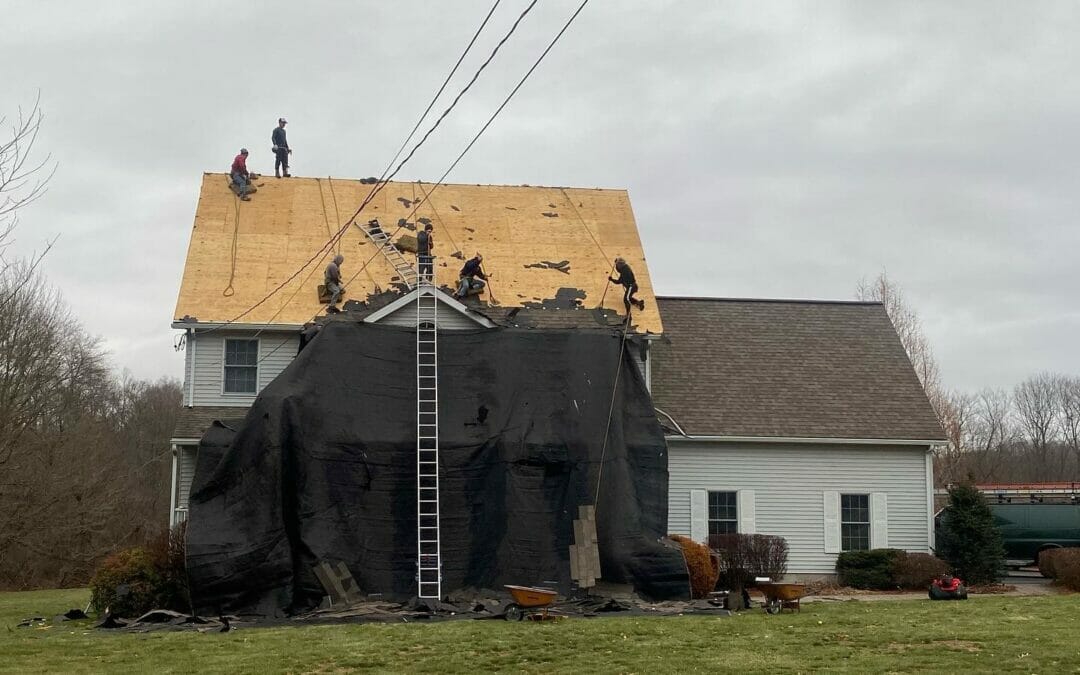
Severe winds, thunderstorms, and hail can cause great damage to a roofing system. High-force winds can blow individual shingles off the roof, exposing the surfaces below the elements. Hail can create holes in the roof as well. If these areas are not repaired, more expensive complications can occur in the future. What should be done when storms damage your roof?

Take Pictures
When a storm has passed and it is safe to go outside, make sure to take several pictures of the damage to your home. It may be difficult to see all of the damage, but take as many pictures as you can. Please use caution if you decide to climb a ladder to note the damage. Taking videos may be wise also.
Call a Trusted Roofing Professional
Contact a local roofing company to inspect your roof. Especially if you have concerns about climbing on your roof. They have the safety equipment to climb up and inspect damaged areas. An honest company will speak with you about the damages caused and advise you on the choices you can make. Here are some items to consider when speaking with a roofing company.
- Make sure the company is fully insured, with General Liability and Workmen’s Comp, before the team climbs on your roof.
- Do not sign any paperwork the roofing company presents until after the inspection is done, and a plan can be put in place.
- Do not give the roofing company any money up front to do the inspection. It should be a free inspection.
- Know what the roofing company is doing during the inspection. Be present.
- Ask for the company’s license number if you are not familiar with them.
It can be a daunting task to search for a company that meets all of these criteria. Place your trust in Simple Roofing in New Jersey. We take pride in our work and follow honest simple principles daily by providing the best materials and workmanship possible. We treat our customers like family, with courtesy and respect. You will never have to guess what to do next or wonder about the quality of the roof when you speak with us. We value you and your home. (If you are in need of gutter replacement or repair you can click here!)
Contact Your Insurance Agent
The next step is to contact your insurance agent. It is advised not to contact the company, but your agent. The agent can readily look up your policy and provide you with specific advice and steps moving forward. If you have questions or concerns, your agent will take the time to help. Ask for copies of all paperwork for your files. While most insurance policies cover hail and damage, make sure you understand your specific policy and any “acts of God” clauses.
Trust the professionals at Supreme Roofing to assist with replacing or repairing your roof after storm damage. We have more than two decades of experience in the roofing industry and we understand the specific needs of our friends and neighbors in New Jersey. We offer top-notch services with premium products you can always count on. We look forward to working with you!
Roof leaking right now? Our 24/7 emergency roof repair team tarps and stabilizes roofs same-day across Passaic, Bergen, and Essex counties — call (201) 429-9607.
 (201) 429-9607